
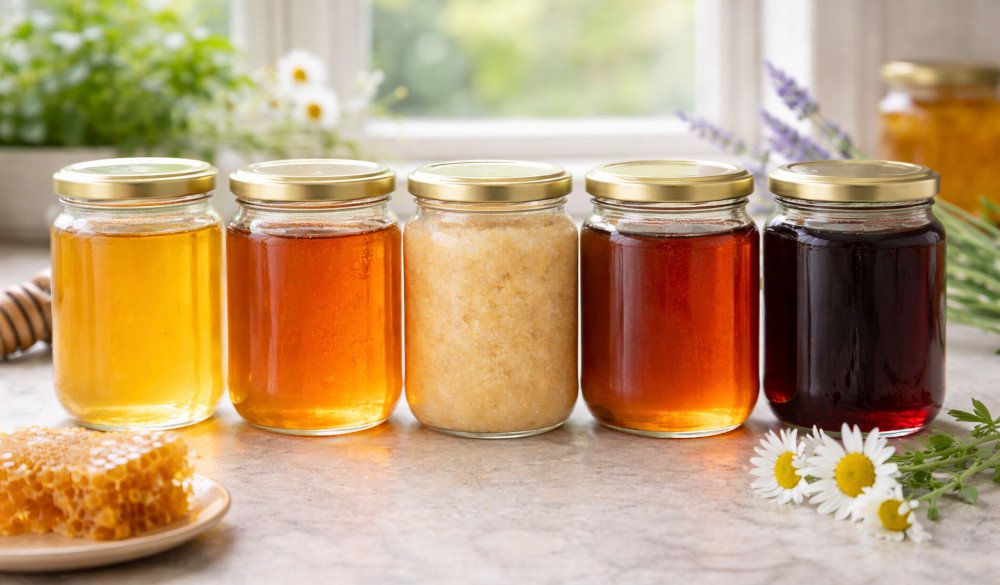
Honey does not have a fixed taste, even when it comes from the same country or region. Many consumers notice that one jar of honey can taste floral and mild, while another tastes dark, earthy, or slightly bitter, even if both are labelled simply as “pure honey”.
This article explains why honey flavour changes, what influences taste differences, and how South African honey varieties contribute to natural variation. It is written for consumers and forms part of the Honey Essentials hub.
Short Answer: Honey Is a Natural, Variable Food
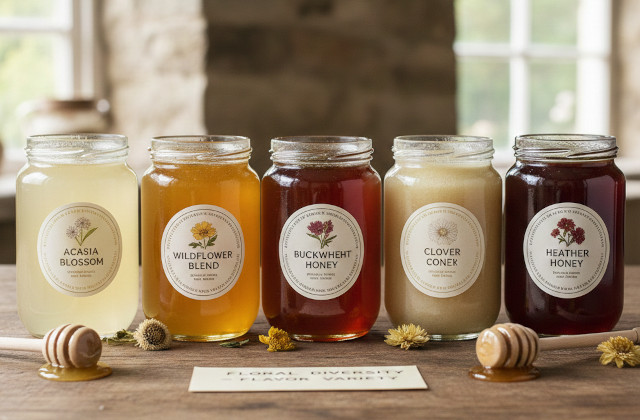
Honey taste changes because it is made from plant nectar, not manufactured to a fixed recipe. Bees collect nectar from different flowers, at different times, under different environmental conditions, and those factors directly affect flavour.
Even when honey is raw, pure, and unadulterated, it will not taste the same from jar to jar.
The Main Factors That Affect Honey Taste
1. Floral Source (Nectar Type)
The biggest influence on honey flavour is the plant species that bees forage on. Nectar chemistry varies widely between plants, and those differences remain present in the final honey.
Light-flavoured honeys often come from citrus blossoms, clover, or wildflowers. Stronger honeys often come from fynbos species, eucalyptus, bushveld flora, or honeydew sources.
In South Africa, bees rarely forage on a single plant type. Most honey is multi-floral, which increases flavour variation.
2. Season and Time of Harvest
Honey harvested in early spring usually tastes lighter and fresher. Honey harvested later in the season often tastes darker and richer.
Rainfall, temperature, and flowering cycles affect nectar concentration. A dry season can produce thicker, more intense honey, while a wetter season can produce lighter-tasting honey.
Two harvests from the same apiary in different months can taste noticeably different.
3. Geographic Region in South Africa
South Africa has highly diverse biomes, and each region contributes its own flavour profile.
Fynbos honey often tastes herbal, floral, or slightly spicy. Bushveld honey can taste darker, malty, or earthy. Citrus-region honey is usually mild and smooth. Karoo and semi-arid areas often produce stronger, concentrated flavours due to nectar scarcity.
Location matters as much as plant type.
4. Natural Sugar Balance
Honey is mainly made up of fructose and glucose, but the ratio differs depending on nectar source.
Higher fructose honey often tastes sweeter and smoother. Higher glucose honey may taste less sweet and crystallise faster. These sugar differences affect mouthfeel, sweetness perception, and aftertaste.
This is why some honeys taste sharp or intense even though they contain no additives.
5. Crystallisation State
Crystallised honey does not taste the same as liquid honey, even though the composition is unchanged. Crystals change how honey dissolves on the tongue.
Crystallised honey often tastes milder and less sweet because sugars release more slowly. Liquid honey often tastes stronger and more aromatic.
This difference is purely physical, not a sign of spoilage or impurity.
Does Processing Affect Taste?
Raw vs Heated Honey
Raw honey retains more volatile aromatic compounds, which contribute to flavour and aroma. Heated or heavily filtered honey often tastes flatter and more uniform.
Commercial processing is designed to create consistency, not flavour depth. This is why supermarket honey often tastes the same every time, while local or raw honey varies.
Variation is usually a sign of minimal processing, not poor quality.
Is Taste Variation a Sign of Fake Honey?
Not necessarily. In fact, consistent taste across batches can sometimes indicate blending or processing.
Pure honey can:
- Change flavour between seasons
- Taste different from batch to batch
- Vary in colour and aroma
Fake or sugar-added honey often tastes very uniform and does not change over time.
Taste variation alone is not proof of authenticity, but it is common in real honey.
Why Some Honey Tastes Strong or “Medicinal”
Certain plants naturally produce strong-tasting nectar. Fynbos species, eucalyptus, and some indigenous shrubs contain aromatic compounds that carry through into honey.
These flavours are sometimes described as bitter, herbal, or medicinal. This does not mean the honey is contaminated or unsafe.
Strong-tasting honey is often higher in antioxidants and plant-derived compounds.
Why the Same Brand Can Taste Different
Even trusted local producers may bottle honey from:
- Different apiaries
- Different harvest dates
- Different forage areas
Unless honey is labelled as single-floral and single-batch, flavour variation is expected.
Small-scale South African beekeepers often prioritise purity over uniformity.
How to Choose Honey Based on Taste Preference
If you prefer mild honey, look for lighter-coloured honey or citrus-region honey. If you prefer stronger honey, choose darker honey from bushveld or fynbos areas.
Reading the origin description is more useful than focusing only on colour or thickness.
Trying honey from different regions is the best way to understand your preference.
Conclusion
Honey tastes different each time because it is shaped by plants, seasons, regions, and natural chemistry. Variation is normal, expected, and often a sign of minimal processing.
Understanding this helps consumers appreciate honey as an agricultural product rather than a uniform sweetener.