
The Stages of a Worker Bee’s Life: From Egg to Forager
A worker bee’s life is short, but remarkably organised. From the moment she begins developing inside a wax cell, her role is shaped by the needs of the colony.
Every worker bee is female. Unlike the queen, she does not normally lay eggs. Instead, she performs most of the work needed to keep the hive alive. She cleans cells, feeds larvae, produces wax, stores food, guards the entrance and eventually leaves the hive to collect resources.
The change from one job to another is known as age-related division of labour. Younger bees generally work inside the hive, while older bees take on more dangerous duties outside it.
The exact timing can vary. A colony may move workers into new roles earlier or later depending on food supplies, weather, the size of the brood and the number of available bees.
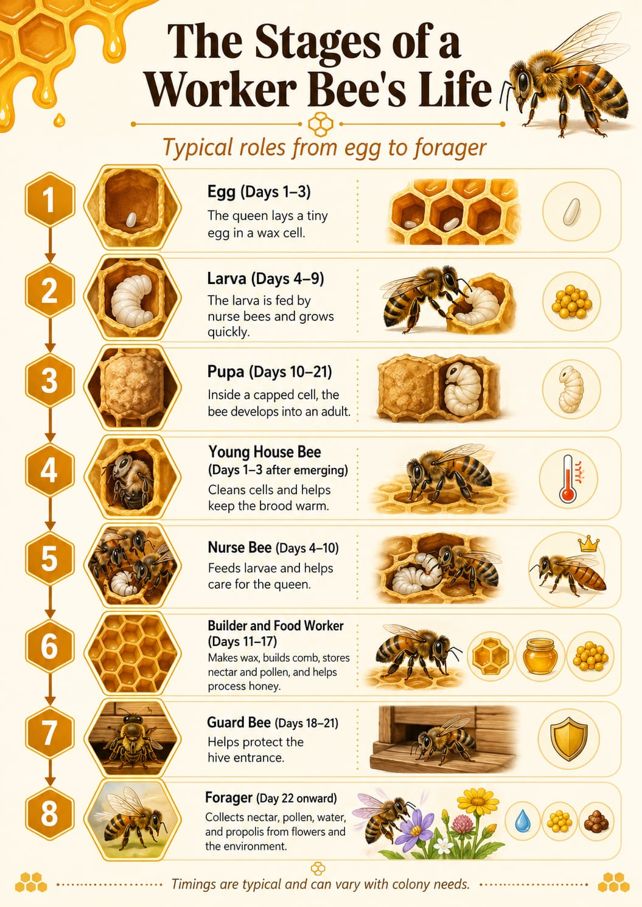
The Two Main Phases of a Worker Bee’s Life
A worker bee’s life can be divided into two broad phases:
- Development inside the cell, from egg to adult.
- Adult work, beginning inside the hive and ending with foraging outside it.
It takes approximately 21 days for a worker bee to develop from an egg into an adult bee.
1. Egg Stage: Days 1–3
The life of a worker bee begins when the queen places a fertilised egg inside a worker-sized wax cell.
The egg is tiny, white and shaped like a small grain of rice. It usually stands upright when first laid and gradually leans over as it develops.
For about three days, the embryo grows inside the egg. At the end of this period, the egg hatches into a larva.
The queen can lay hundreds or even thousands of eggs during periods when the colony is growing rapidly. However, the number depends on the season, food availability and the strength of the colony.
2. Larval Stage: Days 4–9
A newly hatched larva looks like a small white grub. It has no wings, legs or visible resemblance to an adult bee.
Nurse bees visit the cell frequently and provide the larva with food. During its first days, it receives nutrient-rich glandular food produced by young worker bees. Its diet then changes as it grows.
The larva develops very quickly. It eats almost constantly and sheds its skin several times as its body increases in size.
By around the ninth day after the egg was laid, the larva has grown enough to fill much of the cell. Worker bees then cover the cell with a breathable wax cap.
3. Pupal Stage: Days 10–21
Once the cell has been capped, the larva begins changing into an adult bee.
This is the pupal stage. Inside the sealed cell, the bee develops:
- Legs
- Wings
- Compound eyes
- Antennae
- Body hairs
- The familiar head, thorax and abdomen of an adult bee
Although the cell may appear inactive from the outside, a major transformation is taking place inside.
At around day 21, the fully developed worker bee chews through the wax capping and emerges into the hive.
She is now an adult, but she does not immediately fly out to collect nectar.
4. Young House Bee: First Three Days After Emerging
The worker bee’s first jobs are usually performed close to the cell from which she emerged.
One of her earliest tasks is cleaning wax cells. These cells must be prepared before the queen can lay new eggs in them or before food can be stored.
Young house bees may also help:
- Remove waste from the brood area
- Keep developing brood warm
- Polish and prepare cells
- Maintain the cleanliness of the hive
Clean cells are essential to colony health. The queen will usually inspect a cell before placing an egg inside it.
5. Nurse Bee: About Days 4–10
As her food-producing glands develop, the worker becomes a nurse bee.
Nurse bees care for the colony’s developing larvae. They inspect brood cells, feed larvae and help regulate conditions around the brood nest.
They may also attend to the queen by:
- Feeding her
- Cleaning her
- Grooming her
- Distributing her chemical signals through the colony
The queen depends heavily on her attendants. Although she is responsible for laying eggs, workers provide most of her food and daily care.
A strong supply of nurse bees is especially important when the colony has large numbers of developing larvae.
6. Builder and Food Worker: About Days 11–17
During the middle part of her adult life, a worker bee may perform several different jobs inside the hive.
Producing wax and building comb
Worker bees have wax glands on the underside of their abdomens. These glands produce small wax scales.
The bees collect, soften and shape the wax to build the hexagonal cells of the comb. These cells are used for:
- Raising young bees
- Storing honey
- Storing pollen
Comb building requires warmth and energy. Bees often hang together in groups while producing and shaping wax.
Receiving nectar
Forager bees returning to the hive pass nectar to younger house bees.
The house bees help process the nectar by moving it between bees and placing it into comb cells. Water gradually evaporates from the nectar until it becomes concentrated enough to be stored as honey.
The bees then seal mature honey inside the cell with a wax cap.
Storing pollen
Pollen brought into the hive is packed into cells near the brood area. It provides protein, fats, vitamins and minerals needed by developing larvae and young bees.
Ventilating the hive
Workers may stand near the hive entrance and fan their wings. This creates airflow through the colony.
Ventilation helps:
- Cool the hive
- Reduce excess moisture
- Help nectar lose water
- Maintain suitable brood conditions
Some workers also collect water, which can be spread inside the hive and cooled through evaporation.
7. Guard Bee: About Days 18–21
As a worker becomes older, she may begin guarding the hive entrance.
Guard bees inspect bees attempting to enter the colony. They use scent to help recognise members of their own hive.
They may challenge:
- Bees from other colonies
- Wasps
- Other insects
- Small animals trying to enter the hive
Guard bees also respond to movement, vibration and unusual smells near the entrance.
Not every bee spends the same amount of time guarding. The number of guards can increase when the colony is threatened or when food shortages make robbing by other bees more likely.
8. Forager Bee: From About Day 22 Onwards
Foraging is usually the final major stage of a worker bee’s life.
Forager bees leave the safety of the hive to collect resources needed by the colony.
These include:
Nectar
Nectar is a sugary liquid produced by flowers. Bees carry it in a specialised internal storage organ often called the honey stomach.
Back at the hive, the nectar is passed to house bees for processing.
Pollen
Pollen provides much of the protein needed by the colony.
A forager brushes pollen from her body and packs it into structures on her hind legs known as pollen baskets. These colourful pollen loads are often visible when bees return to the hive.
Water
Water is used to cool the hive, dilute food and support normal colony functions.
During hot South African summers, water collectors can become especially important. Bees may repeatedly visit birdbaths, taps, swimming pools and other reliable water sources.
Propolis
Propolis is a sticky material made from plant resins.
Bees use it to seal small gaps, strengthen parts of the hive and coat certain surfaces. For this reason, propolis is sometimes described as “bee glue”.
Worker Bee Roles Are Flexible
The stages shown in the infographic are typical, but they should not be seen as a strict timetable.
A worker bee’s job is influenced by both her age and the needs of the colony.
For example, if many foragers are lost, younger bees may begin foraging earlier. If the colony suddenly has more larvae to feed, older workers may return to brood-care duties.
This flexibility helps the colony respond to:
- Bad weather
- Food shortages
- Predator attacks
- The loss of workers
- Sudden increases in brood
- Seasonal changes
A bee colony therefore works less like a rigid production line and more like a responsive living system.
How Long Does a Worker Bee Live?
A worker bee’s lifespan depends largely on the season and the amount of work she performs.
Workers born during busy spring and summer periods often live for only a few weeks. Foraging is physically demanding and exposes bees to weather, predators, pesticides and the risk of becoming lost.
Workers produced for winter can live much longer. Because there is less brood rearing and foraging during colder periods, these bees may survive for several months.
The lifespan of an individual worker may be short, but the colony continues because new workers are constantly being raised.
Why Worker Bees Are Essential
The queen may be the only bee laying large numbers of eggs, but she cannot maintain the colony alone.
Worker bees are responsible for nearly every other important activity, including:
- Caring for the brood
- Building and repairing comb
- Producing and storing honey
- Collecting pollen and water
- Regulating hive temperature
- Cleaning the colony
- Guarding the entrance
- Supporting and feeding the queen
Thousands of workers cooperate to keep the hive functioning. Their changing roles allow the colony to use each bee where she is most useful at that stage of her life.
A Short Life With Many Jobs
The journey from egg to forager takes a worker bee from complete dependence inside a wax cell to one of the colony’s most demanding and dangerous jobs.
She begins by developing in the protected brood nest. After emerging, she works through a series of duties inside the hive before eventually flying out to collect the food and materials on which the entire colony depends.
The dates are not fixed, and not every bee follows exactly the same path. However, the overall pattern shows how effectively honey bees organise their work.
A single worker may live for only a few weeks, but during that time she contributes to the survival of a colony that can contain tens of thousands of bees.