
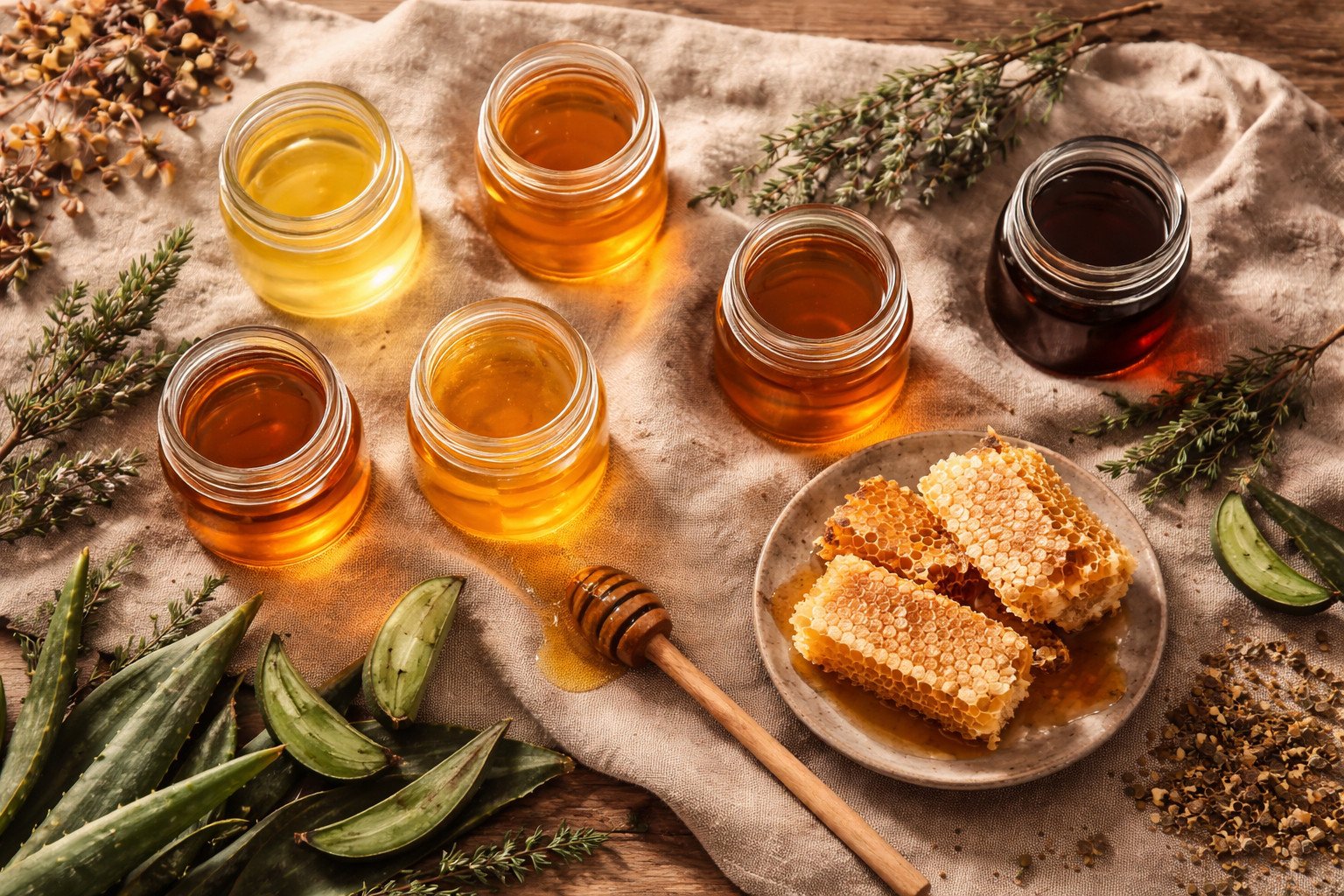
Complete Guide to Honey in South Africa
South Africa is home to some of the world’s most extraordinary honeys.
From the legendary Fynbos biome of the Western Cape to the ancient aloe fields of the Karoo, South African bees forage across nine distinct biomes, producing honeys of remarkable diversity, flavour, and medicinal value.
Yet the honey market here is also one of the most confusing — and one of the most compromised — in the world. Fake, adulterated, and heavily processed products dominate supermarket shelves, often sold at suspiciously low prices.
Understanding what to look for is no longer just about taste; it’s about your health, your money, and supporting the South African beekeeping industry that keeps our agriculture alive.
This complete guide covers everything: how to spot fake honey, the difference between raw and processed, the best local honey varieties for health, how to store it properly, and exactly where to buy the real thing in South Africa.
1. Real Honey vs Fake Honey in South Africa
Honey fraud is one of the most widespread food adulteration problems globally — and South Africa is not immune. Understanding the scale of the problem is the first step to protecting yourself.
The Extent of the Problem
Globally, studies suggest that as much as 46% of commercial honey may be adulterated with cheaper sweeteners.
South Africa imports enormous volumes of honey, much of it from China — a country notorious for honey adulteration globally.
Imports of Chinese honey into South Africa spiked from just 20 tonnes in 2001 to approximately 3,600 tonnes by 2017, while local hive production fell from around 3,000 tonnes to roughly 1,500 tonnes per year over the same period.
South Africa’s investigative TV programme Carte Blanche exposed the issue in 2018, revealing that adulterated honey was reaching the shelves of trusted South African retail chains, in-house honey brands, and private label bottles. Some local producers were also found guilty — Grandis Apiaries in Howick, for instance, was found to have fed sugar rather than pollen to its bees.
| ⚠️ The ‘Packaged in South Africa’ Trap Some companies use the words ‘Packed in South Africa’ to mislead consumers into believing they’re buying locally-produced honey, when in fact the honey itself is imported and adulterated. Always look specifically for ‘Produced in South Africa’ or ‘Product of South Africa’ on the label. |
What is Fake Honey Made Of?
Adulterated honey is typically real honey diluted — or replaced entirely — with cheap substitutes, including:
- High-fructose corn syrup (HFCS)
- Rice syrup — one of the hardest adulterants to detect
- Sugar beet syrup
- Inverted cane sugar
- Added water to increase volume
These additives can mimic honey’s appearance and sweetness, but they strip away all the enzymes, antioxidants, pollen, and bioactive compounds that make real honey genuinely beneficial.
Legal Definition of Real Honey in South Africa
South African law is clear. Under the Agricultural Product Standards Act (Act No. 119 of 1990), and specifically Regulation R.835/2000, honey is legally defined as:
| “The sweet foodstuff derived from the nectar of flowers, sugary excretions of insects, plant juices or sugary secretions of living plant parts other than flowers, after it has been gathered, partially converted and stored in the comb by honeybees or stingless bees.” The regulation also states that for a product to be labelled ‘honey’, it must consist only of honey, with no additions whatsoever. Products containing additives must be clearly labelled to reflect this. |
Honey adulteration is, at its core, fraud. Unfortunately, there are currently no laboratories recognised under the South African national accreditation system to test for honey adulteration domestically, meaning samples must be sent overseas for reliable testing — a costly process that makes effective enforcement difficult.
How to Identify Real Honey: The PPP Test
South Africa’s oldest honey brand, Peel’s Honey, developed a practical ‘PPP’ test for consumers:
| PPP Factor | What to Look For |
| Price | In South Africa, a 500g bottle of genuine, locally-produced honey should cost between R100 and R130. If it’s priced at R65–R80, be very suspicious — that barely covers a beekeeper’s harvest cost, let alone bottling and distribution. |
| Provenance | Look for clear, specific origin information: which region, which beekeeper, which floral source. Vague labels are a red flag. |
| Packaging | Cheap, brightly coloured plastic squeeze bottles are a warning sign. Genuine local honey tends to be sold in glass jars with clear, honest labelling. |
Home Tests for Honey Purity
While no home test is perfectly reliable against modern sophisticated adulterants, these checks provide useful clues:
| Test | Method & What It Means |
| Water Test | Drop a spoonful of honey into a glass of water. Pure honey tends to clump and sink slowly without dissolving quickly. Adulterated honey may dissolve or disperse easily. Note: thick syrups can also pass this test, so don’t rely on it alone. |
| Methylated Spirits Test | Mix equal parts honey and methylated spirits. Real honey settles at the bottom. Fake honey dissolves into the spirits, turning the solution milky. |
| Foam/Heating Test | When gently heated, pure honey caramelises without excessive foaming. Fake honey may foam and bubble due to added moisture and sugars. |
| Crystallisation Check | Real honey crystallises naturally over time. If your honey has been liquid for years and never shows any crystallisation, be suspicious. (Note: some genuine varieties like Acacia crystallise very slowly.) |
| Taste & Aroma | Genuine honey has a complex, multi-layered flavour with floral notes and a pleasant aroma. Fake honey typically tastes one-dimensionally sweet — like golden syrup — with little complexity or aftertaste. |
| 🔬 The Limits of Home Testing Modern adulterants — especially rice syrup and inverted sugar — have been specifically engineered to pass basic home tests. The only way to detect sophisticated adulteration with certainty is through laboratory testing methods such as NMR spectroscopy, LC-HRMS, or DNA barcoding. This is why buying from trusted, transparent local producers remains the most practical safeguard for South African consumers. |
The Irradiation Issue: Imported Honey’s Hidden Secret
By South African law, all imported honey must be irradiated — exposed to radiant energy — to control diseases and kill pathogens.
While this process makes the honey safe in a microbiological sense, it also destroys many of the beneficial enzymes, proteins, and some vitamins (particularly Vitamin E) that make raw honey valuable for health. Most of the convenient, cheap honey in squeeze bottles on supermarket shelves is imported and irradiated.
2. Raw Honey vs Processed Honey
Even among genuine, unadulterated honey, there is a crucial spectrum from ‘raw’ to heavily processed. Understanding this distinction is essential for any health-conscious South African consumer.
What is Raw Honey?
Under South African regulation R.835, raw honey is legally defined as honey that is both unfiltered (has not passed through a filter under pressure) and unheated (has not been heated above hive temperature — roughly 35°C).
In practice, truly raw honey:
- Retains all natural enzymes, amino acids, vitamins, and minerals
- Contains bee pollen, propolis traces, and beeswax particles
- Has not been pasteurised
- May appear cloudy, opaque, or partially crystallised
- Has a more complex, sometimes stronger flavour
Raw honey is the most nutritionally complete form of honey. Its natural enzyme profile — including diastase, invertase, and glucose oxidase — is what gives it genuine antimicrobial and healing properties. These enzymes are destroyed or significantly reduced by heating.
What is Processed (Commercial) Honey?
Most honey sold in South African supermarkets has been processed to some degree.
Processing typically involves:
- Pasteurisation: Heating to around 70°C to kill bacteria, reduce fermentation risk, and produce a clear, attractive product
- Fine filtration: Removing pollen, wax, and other particles under pressure for a cleaner appearance
- Blending: Mixing honey from multiple sources or regions
- Irradiation: For all imported honey, as required by law
Processed honey is safer from a strict food-safety perspective, resists crystallisation for longer, and pours easily — which is why it dominates retail shelves. However, it is nutritionally inferior to raw honey, with reduced antioxidant activity and no live enzymes.
Creamed Honey: A Special Category
Creamed honey (also called whipped honey) is a popular middle ground. It is made by taking raw honey and gently whipping it, or seeding it with a tiny starter crystal, to produce a large number of uniformly tiny crystals. The result is a smooth, spreadable, butter-like consistency.
The good news: the creaming process does not destroy the beneficial properties of honey. Creamed honey retains all the same health benefits as raw honey.
It is simply a different texture, making it ideal for spreading on toast or bread. Look for creamed honey made from raw South African honey for the best of both worlds.
Honeycomb: The Gold Standard
Honeycomb is honey in its most natural and unprocessed form — the honey sealed within the wax cells as the bees left it.
It has undergone no heating, filtering, or processing of any kind. Both the honey and the wax comb are safe and delicious to eat. It is the benchmark of authenticity. Honeycomb is also one of the easiest ways to verify you are buying real honey, since it is almost impossible to fake convincingly.
| Type | Key Characteristics |
| Raw Honey | Unheated, unfiltered. Maximum enzyme and antioxidant content. May be cloudy or crystallised. Best for health benefits. |
| Creamed Honey | Raw honey whipped to a smooth consistency. Retains all raw honey benefits. Easy to spread. Excellent choice. |
| Processed Honey | Pasteurised and filtered. Clear, long shelf life, easy to pour. Reduced enzymes and antioxidants. |
| Irradiated Honey | All imported honey. Reduced beneficial enzymes and some vitamins. Avoid if health benefits are the priority. |
| Honeycomb | Completely unprocessed. Impossible to fake convincingly. The purest form available. |
3. South African Honey Varieties: A Regional Guide
South Africa’s nine biomes are home to an extraordinary diversity of flowering plants, and the honeys produced from them are equally varied in colour, taste, aroma, and health properties.
There are two honeybee species found in South Africa: Apis mellifera scutellata (the African wild bee, found inland) and Apis mellifera capensis (the Cape honeybee, found along the coastline).
Here is a guide to the most notable and sought-after South African honey varieties:
Fynbos Honey
Arguably South Africa’s most famous and prized honey, Fynbos honey comes exclusively from the Fynbos biome of the Cape Floral Kingdom — one of the world’s six floral kingdoms and found only at the southern tip of Africa.
This is the only place on earth where this honey exists.
- Colour: Light yellow to deep dark amber, varying by season and hive location
- Flavour: Strongly floral, complex, and slightly earthy. Changes between seasons.
- Health notes: Exceptionally high in polyphenols and antioxidants due to the extraordinary biodiversity of fynbos plants. Rich in flavonoids. One of the most antioxidant-dense honeys in the world.
- Availability: Harvested mainly during winter months in the Western Cape
- Best for: Health supplementation, immune support, wound care, sore throats
Buchu Honey
Buchu (Agathosma betulina) is an indigenous Cape plant long used in traditional medicine by the Khoisan people of South Africa. Buchu honey is made by bees foraging on buchu flowers in the Western Cape mountains.
- Colour: Light amber
- Flavour: Distinctive herbal, slightly fruity notes — recognisably different from other honeys
- Health notes: Known for strong anti-inflammatory properties, antimicrobial activity, and support for urinary tract health. Traditionally used for kidney complaints, arthritis, and digestive issues. Buchu-infused honey is popular during cold and flu season for respiratory support.
- Best for: Anti-inflammatory use, urinary health, cold and flu season
Aloe Honey
With approximately 150 aloe species in South Africa, aloe honey is a uniquely South African product, typically produced during winter when most other plants are not flowering.
- Colour: Whitish to pale, unusually light
- Flavour: Delicate and mild, lighter than most honeys
- Health notes: The aloe plant’s medicinal properties are well-documented. Aloe honey carries some of these anti-inflammatory and wound-healing benefits. Its higher water content makes it popular for creamed honey.
- Seasonality: Winter-only, making it a valuable source for bees in cold months
Acacia Honey
Light, mild, and slow to crystallise, acacia honey is one of South Africa’s most versatile and accessible honeys.
- Colour: Very light, almost water-white to pale gold
- Flavour: Mild, delicately sweet, does not overpower other flavours
- Health notes: Naturally low sucrose content. Does not crystallise quickly due to high fructose content. Good choice for diabetics managing sugar intake (always consult a doctor first).
- Best for: Cooking, baking, drizzling. A good all-round pantry honey.
Sunflower Honey
A major commercial honey in South Africa given the large-scale cultivation of sunflowers in the North West and Free State provinces.
- Colour: Bright golden yellow
- Flavour: Sweet, mild, and pleasant
- Notes: Crystallises quickly due to high glucose content — sometimes even in the hive. Abundant and widely available from local beekeepers.
Other Notable South African Honey Varieties
| Variety | Notes |
| Eucalyptus / Bluegum | Strong, slightly medicinal flavour. Good antimicrobial properties. Widely available. |
| Orange Blossom / Citrus | Light, fragrant, and floral. From citrus-growing regions in the Eastern Cape and Western Cape. |
| Macadamia | Produced in the subtropical regions of Mpumalanga and Limpopo. Rich and buttery. |
| Wildflower / Bushveld | A blend from multiple flowering species in South Africa’s bushveld. Robust, rich flavour. |
| Lucerne / Alfalfa | Light and sweet. Widely used in cooking. Less likely to overpower other flavours. |
| Litchi | From the subtropical Lowveld. Delicate and fruity. Seasonal and harder to find. |
4. Best Honey for Health in South Africa
Raw honey — particularly from diverse South African biomes — is one of nature’s most remarkable functional foods. Here is what the science says, and how to choose the right variety for your specific health needs.
General Health Benefits of Raw Honey
- Antioxidant-rich: Contains flavonoids and phenolic acids that combat oxidative stress, reducing the risk of chronic disease
- Antimicrobial properties: The enzyme glucose oxidase produces hydrogen peroxide, giving honey natural antibacterial activity even against resistant strains
- Wound healing: Honey’s low water activity, acidity, and antimicrobial compounds make it effective for wound care and burns — medical-grade honey products are used in hospitals globally
- Sore throat and cough relief: A spoonful of raw honey has been shown in clinical studies to be as effective as some commercial cough medicines
- Prebiotic effects: Raw honey supports beneficial gut bacteria and digestive health
- Energy: Natural sugars (fructose and glucose) provide readily available energy, making honey ideal for athletes and post-illness recovery
- Sleep support: The natural sugars in honey may support serotonin production, which converts to melatonin
| ⚠️ Important Safety Note Honey should NEVER be given to infants under 12 months of age due to the risk of infant botulism. This applies to all forms of honey including raw, pasteurised, and creamed. People with diabetes should consult their doctor before using honey as a sugar substitute, as it still raises blood glucose levels. |
Best Honey by Health Goal
| Health Goal | Best South African Honey Choice |
| Maximum antioxidant intake | Fynbos honey (raw, dark amber variety) — one of the richest polyphenol sources available locally |
| Anti-inflammatory support | Buchu honey or Buchu-infused raw honey from the Cape |
| Wound care or skin healing | Raw fynbos or raw wildflower honey; apply topically on minor wounds |
| Sore throat and cough relief | Raw honey of any variety — 1 teaspoon neat or dissolved in warm (not boiling) water with lemon |
| Gut health and digestion | Any raw, unprocessed honey — the live enzymes support digestive function |
| General daily use | Raw acacia, wildflower, or creamed fynbos honey — consistent, versatile options |
| Athletic performance | Any pure raw honey — a teaspoon before exercise provides fast, natural energy |
| Allergy management | Some evidence suggests local raw honey (containing local pollen) may help build tolerance to seasonal pollen allergens over time — though scientific evidence is mixed |
A Note on Manuka Honey in South Africa
Manuka honey from New Zealand has a strong international reputation for its high MGO (methylglyoxal) content and documented antibacterial properties. It is widely available in South Africa, but note: all imported honey — including Manuka — must be irradiated by South African law.
This irradiation process reduces some of its beneficial properties. Manuka honey in South Africa also costs significantly more than local alternatives (R766+ per 250g as of recent estimates).
For most health purposes, high-quality raw South African Fynbos or Buchu honey offers comparable or superior benefits at a fraction of the cost, while also supporting local beekeepers.
5. How to Store Honey Correctly
Honey is one of the very few foods that, stored correctly, can last indefinitely. Archaeologists have found 3,000-year-old honey in Egyptian tombs that was still edible.
However, incorrect storage can cause fermentation, crystallisation problems, or degradation of its health properties.
The Golden Rules of Honey Storage
- Store at room temperature, ideally between 18°C and 24°C — typical South African indoor conditions are usually perfect
- Keep in a tightly sealed container to prevent moisture absorption — honey is hygroscopic (it absorbs water from the air), and excess moisture causes fermentation
- Store in glass jars wherever possible. Glass is non-reactive and does not leach chemicals into the honey. If using plastic, ensure it is food-grade BPA-free plastic.
- Keep away from direct sunlight and heat sources. Light and heat degrade the beneficial enzymes and antioxidants in raw honey.
- Do NOT refrigerate honey. Cold temperatures accelerate crystallisation and make honey very thick and difficult to use.
- Never store honey in metal containers, as the acids in honey can react with metals, affecting both taste and quality.
| 🍯 Does Honey Ever Expire? Commercially produced honey with a moisture content below 17.1% has an indefinite shelf life due to its low water activity, acidity, and hydrogen peroxide content — all of which prevent bacterial growth. Raw honey with slightly higher moisture content can ferment if exposed to air. A ‘best before’ date on your honey jar is about quality, not safety. If stored correctly in a sealed container, properly-produced honey will not go bad. |
What to Do When Your Honey Crystallises
Crystallisation is a completely natural process in real honey — in fact, it is one of the most reliable signs that your honey is genuine. It happens because glucose (one of honey’s main sugars) naturally precipitates out of solution over time.
Some South African varieties crystallise quickly (sunflower honey can solidify within weeks), while others like acacia honey remain liquid for much longer.
To re-liquefy crystallised honey:
- Place the jar in a bowl of warm water (not boiling — never exceed 40°C for raw honey to preserve enzymes)
- Stir gently as it warms
- Alternatively, leave it in a warm spot in your kitchen for a few hours
- Never microwave honey, especially raw honey, as this destroys its enzymes and beneficial compounds
Storing Different Types of Honey
| Type | Storage Notes |
| Raw honey | Same rules apply. Keep sealed, at room temperature, away from light. Will crystallise faster than processed honey — this is normal and beneficial. |
| Creamed honey | Store at room temperature. Do not refrigerate. Keep sealed. |
| Honeycomb | Can be stored at room temperature. Keep wrapped or sealed to prevent drying out. Best consumed within a few months. |
| Infused honey (buchu, ginger, etc.) | Check producer instructions. Most infused honeys should be refrigerated after opening due to the added botanical ingredients. |
6. Where to Buy Real Honey in South Africa
Given the scale of honey fraud in South Africa, knowing where to buy genuinely matters.
Here is a breakdown of your best options, from most to least reliable:
Direct from the Beekeeper or Farm
The most reliable way to buy genuine, unadulterated South African honey is directly from a beekeeper. You can see the operation, ask questions, and verify the honey’s provenance firsthand.
Look for beekeepers who:
- Can tell you exactly which region and which flowering plants the bees forage on
- Will allow a farm visit or show transparent information about their operation
- Do not heat or pressure-filter their honey
- Are described as ‘badger-friendly’ — a South African certification that also implies ethical, non-destructive beekeeping practices
Farm stalls, farmers’ markets (such as the Oranjezicht City Farm Market in Cape Town, various Slow Food markets in Johannesburg, and similar markets around the country), and roadside farm stalls in regions like the Western Cape and KwaZulu-Natal are excellent places to find direct-from-beekeeper honey.
Reputable South African Honey Brands and Online Retailers
Several South African honey brands and online retailers have built strong reputations for quality and transparency:
| Brand / Retailer | Notes |
| Peel’s Honey | South Africa’s oldest honey brand, founded in 1902. Known for strong provenance standards and quality control. Available nationally. |
| West Coast Honey | Award-winning raw honey from Hopefield, Western Cape. Fynbos, Buchu, and Eucalyptus varieties. Badger-friendly certified. Direct online sales. |
| The Honey Bee Company | Established 1990. 100% South African raw honey, multiple varieties including Bushveld. Strong reputation for quality. Online and direct sales. |
| Darling Honey | Raw, badger-friendly Fynbos honey from Rietfontein farm, Darling. Solar-powered extraction. Available online and at selected retailers. |
| Overberg Honey Company | Raw Fynbos honey from the Overberg region. Unheated, unfiltered. Seasonal availability. |
| Faithful to Nature | Online health retailer stocking a curated selection of raw South African honeys. Good for comparing options and reading product details before buying. |
| Raw Honey Love (rawhoneylove.co.za) | Online resource and retailer focused exclusively on raw South African honey from small beekeepers. Good for niche varieties. |
| Bee Inspired (beeinspired.co.za) | Partners with small, independent South African beekeepers to offer a range of raw honeys. |
Health Shops
Health food shops such as Wellness Warehouse, Faithful to Nature retail stores, and independent health shops around South Africa generally stock a better selection of raw and local honeys than mainstream supermarkets. Staff are often knowledgeable about the products they stock.
This is a reliable middle ground between buying directly from a beekeeper and buying from a supermarket.
Supermarkets: Proceed With Caution
Most honey on mainstream South African supermarket shelves is commercially processed, imported, and potentially adulterated.
If supermarket honey is your only option:
- Look explicitly for ‘Produced in South Africa’ — not just ‘Packed in South Africa’
- Choose glass jars over plastic squeeze bottles where possible
- Expect to pay at least R100 to R130 for a genuine 500g jar — anything cheaper should be approached with caution
- Check the label for any indication of raw, unheated, or unfiltered status
- Avoid products labelled simply as ‘honey blend’ or ‘honey-flavoured’
Farmers’ Markets and Craft Markets
South Africa has a thriving network of farmers’ markets, craft markets, and slow food markets where small-scale beekeepers sell directly to consumers. These are excellent places to find local, raw, and unique varieties.
Markets to explore include:
- Oranjezicht City Farm Market, Cape Town (Saturdays and Sundays)
- Neighbourgoods Market, Cape Town and Johannesburg
- Bryanston Organic Market, Johannesburg
- Hazel Food Market, Johannesburg
- Local Slow Food market events (check Slow Food South Africa)
- Regional farm stalls along the Garden Route such as Wild Oats in Sedgefield and Harkerville Saturday Market near Plettenberg Bay, Overberg, Winelands, and KwaZulu-Natal Midlands
7. Additional Information Every South African Should Know
Bee Products Beyond Honey
South African bees produce several other remarkable products worth knowing about:
| Product | What It Is & Its Uses |
| Propolis | A resinous substance bees collect from tree buds and use to seal the hive. Has powerful antimicrobial, antifungal, and antiviral properties. Available as tinctures, sprays, and lozenges from specialist honey retailers. |
| Royal Jelly | A protein-rich secretion fed by worker bees to the queen. Rich in amino acids, B vitamins, and fatty acids. Used as a supplement for immune support and energy. |
| Beeswax | Used in cosmetics, lip balms, candles, wood polish, and food wrapping. Look for 100% pure South African beeswax products. |
| Bee Pollen | Raw pollen collected by bees and packed into granules. Exceptionally rich in protein, amino acids, vitamins, and antioxidants. Can be added to smoothies or yoghurt. Note: those with pollen allergies should start with tiny amounts. |
Cooking and Using Honey in South Africa
To get the most from your South African honey:
- Never add raw honey to very hot food or boiling liquid — this destroys its enzymes. Add to tea or warm water that has cooled to below 40°C.
- Use strong-flavoured honeys (dark Fynbos, Bushveld) in marinades, dressings, and glazes where the bold taste can shine
- Use mild honeys (Acacia, Lucerne, Sunflower) as a sugar substitute in baking where you don’t want the honey flavour to dominate. Replace 1 cup of sugar with 3/4 cup of honey and reduce other liquids slightly.
- Raw honey pairs beautifully with South African rooibos tea, goat’s milk cheese, sourdough bread, and freshly made vetkoek
- Drizzle over milk tart, malva pudding, or koeksisters for a local twist
Supporting South African Beekeepers
South Africa’s beekeeping industry does far more than produce honey. Bees are essential pollinators for South African commercial agriculture — without them, much of our fruit, vegetable, and nut production would collapse.
The influx of cheap, adulterated imported honey has severely depressed honey prices, making it increasingly difficult for local beekeepers to sustain their operations.
Every time you choose genuine South African honey from a local beekeeper over a cheap imported product, you are:
- Supporting rural livelihoods and small businesses
- Protecting South Africa’s agricultural sector through pollination
- Conserving bee populations that are under threat from habitat loss, pesticides, and disease
- Choosing a product with significantly higher nutritional value
South Africa’s Honey Regulations at a Glance
Honey in South Africa is regulated by the Department of Agriculture, Land Reform and Rural Development (DALRRD) under the Agricultural Product Standards Act (Act 119 of 1990) and specifically Regulation R.835/2000.
Key points:
- Honey sold as ‘honey’ must contain nothing but honey — no additives permitted
- Two commercial grades exist: Choice Grade and Industrial Grade
- Quality is regulated by standards including fructose-to-glucose ratio, density, and HMF (hydroxymethylfurfural) content — a measure of freshness and heat exposure
- Vegan honey substitutes may not use the word ‘honey’ on their packaging
- All imported honey must be irradiated by law
- South Africa does not currently have a formal certification system for ‘raw’, ‘organic’, or ‘non-irradiated’ honey — these terms are used by producers voluntarily and based on their own processes
Quick Reference: South African Honey At a Glance
| Question | Answer |
| Is cheap supermarket honey real? | Often not. Honey below R100 for 500g is a significant red flag for adulteration. |
| Does crystallised honey go off? | No. Crystallisation is a sign of genuine honey. It can be gently re-liquefied. |
| Is imported honey safe? | It is irradiated by law, making it microbiologically safe, but with reduced nutritional value. |
| Which SA honey is best for health? | Dark raw Fynbos honey for antioxidants; Buchu honey for anti-inflammatory use; any raw honey for general benefits. |
| Can diabetics eat honey? | Honey still raises blood glucose. Always consult a doctor. Some varieties like acacia have a lower glycaemic index. |
| Can babies eat honey? | Never under 12 months of age. Risk of infant botulism. |
| Should I refrigerate honey? | No. Room temperature, sealed, away from light is best. |
| How do I know if honey is local? | Look for ‘Produced in South Africa’ — not just ‘Packed in South Africa’. |
Conclusion
South Africa is blessed with some of the most extraordinary honey-producing environments on the planet. From the unique biodiversity of the Fynbos to the ancient aloe fields of the Karoo and the subtropical forests of Limpopo, the range of honeys available here is unmatched.
But accessing the real thing requires vigilance. South Africa’s honey market is flooded with cheap, imported, adulterated products that offer little more than sweetness. By knowing what to look for — the right price point, transparent provenance, proper labelling, and the tell-tale characteristics of raw honey — you can make informed choices that benefit your health and support the South African beekeeping community.
The golden rule is simple: buy local, buy raw, buy from sources you can trust. Your body will thank you — and so will the bees.
🐝 The Bottom Line
Real South African raw honey costs R100–R130 per 500g (2026). It may crystallise. It may look cloudy. It will taste complex and layered, not just sweet. It will be labelled ‘Produced in South Africa’ with a specific origin.
And it will be worth every cent.